
Diverging. The Diverging style’s dominant learning abilities are Concrete
Experience (CE) and Reflective Observation (RO). People with this learning
style are best at viewing concrete situations from many different points of view.
It is labeled “Diverging” because a person with it performs better in situations that
call for generation of ideas, such as a “brainstorming” session. People with a
Diverging learning style have broad cultural interests and like to gather
information. Research shows that they are interested in people, tend to be
imaginative and emotional, have broad cultural interests, and tend to specialize in
the arts. In formal learning situations, people with the Diverging style prefer to
work in groups, listening with an open mind and receiving personalized feedback.
Author: nickgarrett
-
Diverging Learning Style
-
Let’s hope the revisions keep coming as Learning about Learning is a constant learning process…
Experiential Learning Theory:
Previous Research and New Directions
David A. Kolb
Richard E. Boyatzis
Charalampos Mainemelis
Department of Organizational Behavior
Weatherhead School of Management
Case Western Reserve University
10900 Euclid Avenue,
Cleveland, OH 44106
PH: (216) 368 -2050
FAX: (216) 368-4785
dak5,@msn.com
August 31, 1999
The revised paper appears in:
R. J. Sternberg and L. F. Zhang (Eds.), Perspectives on cognitive, learning, and
thinking styles. NJ: Lawrence Erlbaum, 2000. 2
Experiential Learning Theory: Previous Research and New Directions
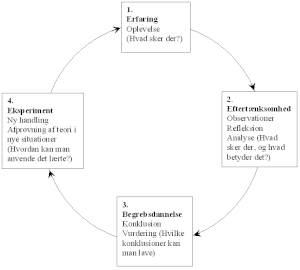
Experiential Learning Theory (ELT) provides a holistic model of the
learning process and a multilinear model of adult development, both of which are
consistent with what we know about how people learn, grow, and develop. The
theory is called “Experiential Learning” to emphasize the central role that
experience plays in the learning process, an emphasis that distinguishes…View original post 6,995 more words
 Nick Garrett